
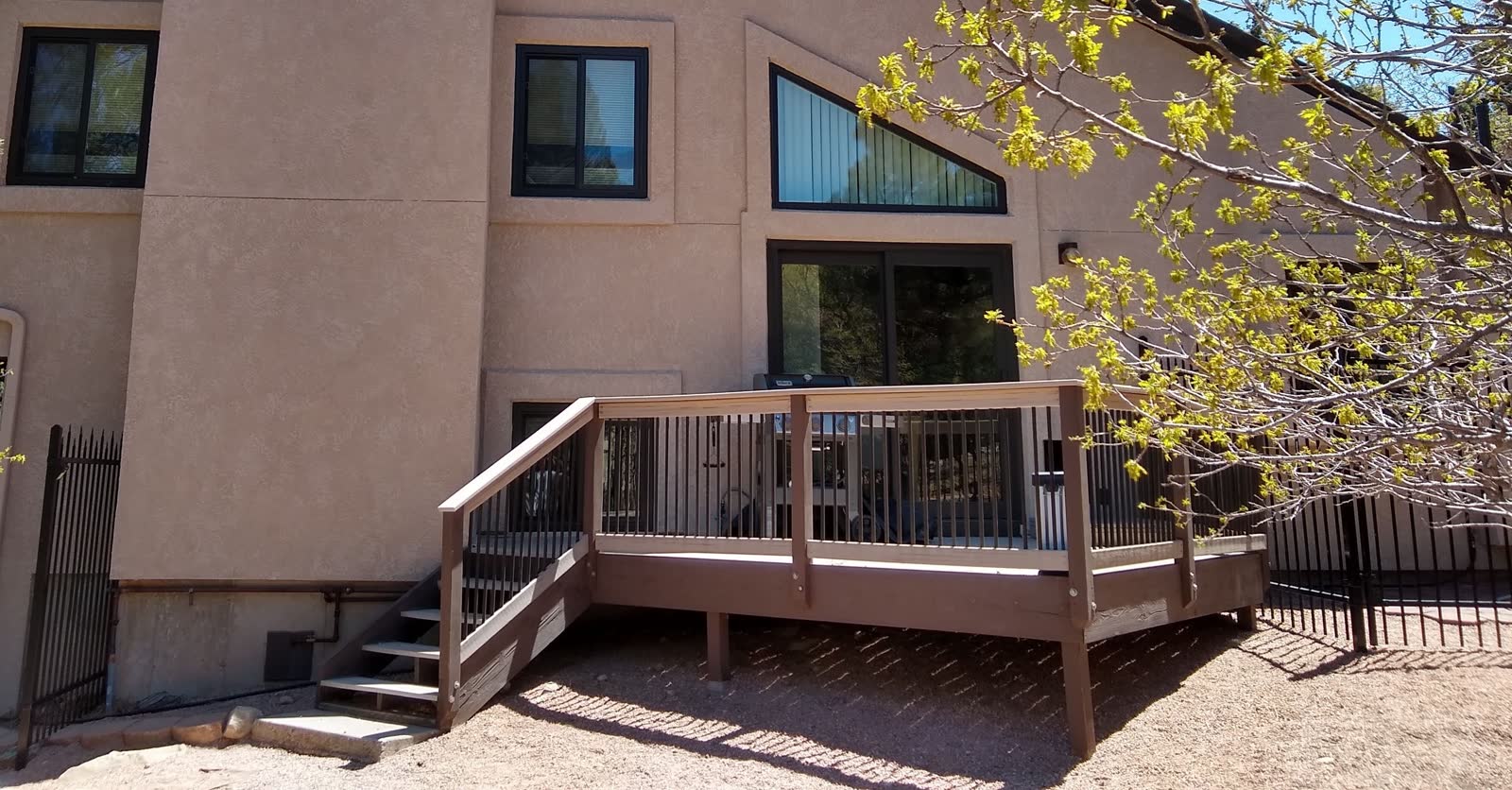
Deck Restoration in Colorado Springs
A grey, splintering deck is not a paint problem. It is a wood problem. High-altitude UV breaks down the lignin that binds the surface fibers, freeze-thaw lifts the grain, and any film finish on top starts peeling. Restoration fixes the wood first.
Why Front Range decks go grey
Sunlight at 6,000 feet carries more UV than the same sun at sea level. UV breaks down lignin, the natural polymer that glues wood fibers together. Once the lignin at the surface degrades, rain rinses it away and leaves loose grey cellulose behind. That grey layer is dead wood. Nothing sticks to it, which is why stain applied over a grey deck fails inside a season.
Colorado adds a second problem. A deck in Colorado Springs or Monument can swing forty degrees between afternoon and midnight, and low humidity pulls moisture out of the boards while snowmelt drives it back in. That cycle raises grain, opens checks, and cups boards away from their fasteners. Restoration has to address both the UV damage and the movement, not just the color.
Stripping the finish that already failed
Most decks we look at have some film on them: a solid color stain, a deck paint, or an old sealer that went milky. Film finishes sit on top of the wood. When water gets underneath through an end grain or a fastener hole, the film lifts and peels in sheets. You cannot recoat over that. The old film has to come off first.
Stripping is chemical, not mechanical. A sodium hydroxide or solvent-based stripper is dwelled on the surface, kept wet, and then lifted with low pressure. Sanding a full film off instead burns through the soft spring wood and leaves a wavy surface that shows through the new stain. If the existing film is sound and you want to stay opaque, deck painting is the better path.
Washing without furring the wood
Pressure washing is where most deck jobs get ruined. Softwood decking starts to erode around 1,200 to 1,500 psi with a fan tip held at a distance. Push a turbo tip into a cedar board and you carve the soft grain out from between the growth rings. That is called furring. It looks clean while wet and turns into a fuzzy, splintering surface as it dries.
The cleaner does the work, not the pressure. A percarbonate or hypochlorite cleaner lifts mill glaze, mildew, and the dead grey layer. Both raise the pH of the wood and darken it. An oxalic acid brightener then neutralizes the surface, pulls the pH back toward neutral, and removes the black tannin and rust stains around fasteners. Skip the brightener and the stain will look blotchy.
After the deck dries, we sand. Not to bare furniture smoothness, because a too-fine surface closes the pores and stops stain from penetrating. Sixty to eighty grit on the walking surface and a hand pass on the handrail is usually right. Sanding knocks down raised grain, removes furring left by previous washes, and leaves an even profile so the finish absorbs at the same rate everywhere.
Boards, fasteners, and the parts that hold it up
Cleaning and staining a deck that is structurally tired is money spent twice. Before any finish goes down we walk the frame. Cupped boards that hold water get flipped or replaced. Boards that are soft at the ends, where end grain wicks moisture, get replaced outright. Popped nails come out and get replaced with coated structural screws set slightly below the surface.
The two failure points worth checking on any older Front Range deck are the ledger and the post bases. The ledger is the board bolted to the house. If it was nailed instead of bolted, or if flashing was left out, water tracks behind it and rots both the ledger and the rim joist. Post bases sitting flat on concrete wick moisture upward and rot from the bottom.
Where a deck meets stucco or siding, the wall detail matters as much as the deck. We flag cracked or drummy stucco at the ledger line while we are there, because that is a water path into the wall, and stucco repair at that joint is cheaper before the framing gets involved.
- Cupped or crowned boards that trap standing water after a storm
- Soft, punky end grain at butt joints and around fastener holes
- Popped nails, rust streaks, loose joist hangers, or missing hardware
- Ledger flashing that was never installed or has pulled away from the wall
- Post bases sitting in direct contact with concrete or soil
Seal and stain, and when to do it
Once the wood is clean, dry, and sound, the finish goes on. Penetrating oil-based and hybrid stains soak into the fiber instead of forming a film, so when they wear they thin out rather than peel. That matters here, because a finish that fails gracefully means the next maintenance coat is a wash and recoat instead of another full strip.
Moisture content and temperature control the schedule. Wood should read at or below fifteen percent on a meter, and the surface should sit between roughly 50 and 90 degrees while the coating cures. That rules out staining a deck the day after a spring snow in Woodland Park or Monument, and it rules out a south-facing deck at two in the afternoon in July.
Two coats is our standard, applied inside the product's recoat window so the second coat bonds to the first instead of sitting on a cured surface. Horizontal boards, stair treads, and the tops of handrails take the most UV and wear, so they get the attention. We restore decks across Colorado Springs, Fountain, Manitou Springs, Canon City, Pueblo, Castle Rock, and the rest of our service areas.
Common questions
Most residential decks run a few days of work spread across a longer window, because the wood has to dry between steps. Stripping and washing happen first. The deck then needs to dry, often two to three days in Colorado's low humidity, before sanding and staining. Rain or a cold snap extends it. We schedule around the forecast rather than staining wet wood.
Grey usually means surface damage, not structural failure. UV breaks down the lignin in the top layer of fiber, and that layer washes and sands off to reveal sound wood underneath. Replacement is the answer when boards are soft and punky through their thickness, when joists or the ledger are rotted, or when a large share of boards are cracked through.
Stain penetrates the wood and wears thin over time. Paint and solid film finishes sit on the surface and eventually peel, especially on horizontal boards that hold water and take direct sun. On walking surfaces a penetrating stain is usually the lower-maintenance choice. Paint makes more sense on railings, skirting, and pergola posts, or on a deck already carrying a sound film.
Late spring through early fall. The wood needs to reach roughly fifteen percent moisture or less, and the surface should stay between about 50 and 90 degrees while the finish cures. Colorado's dry air speeds drying, but large overnight temperature drops and afternoon thunderstorms both matter. Early summer and September often give the steadiest windows along the Front Range.
Get a quote
Free estimate, this week.
Tell us what you are looking at. We will come walk the property, find the cause, and leave you with a written, itemized number. No charge for the visit.
Colorado Springs, CO 80921