
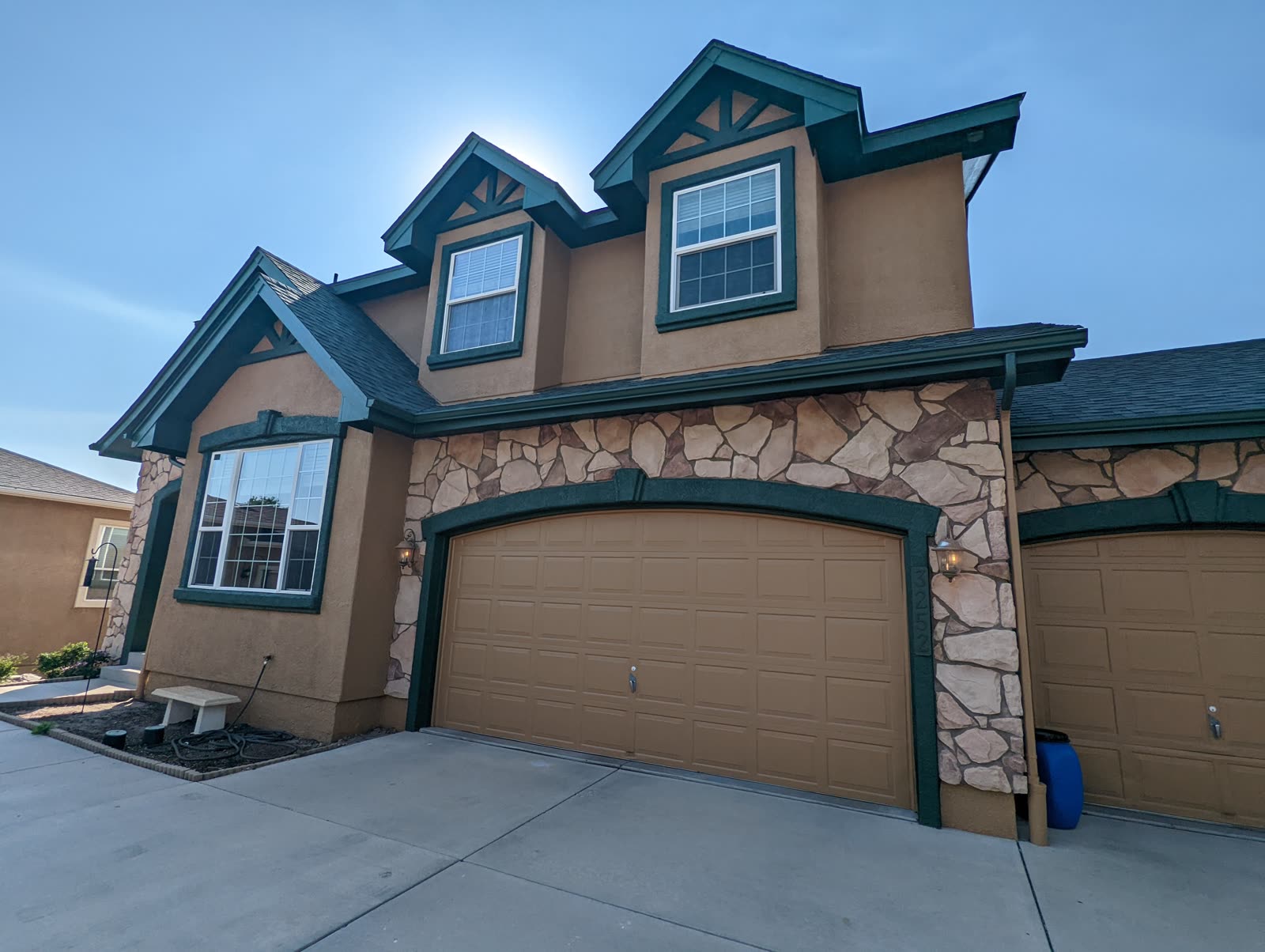
House Painting in Colorado Springs
Paint fails fast at 6,000 feet. UV at altitude breaks down binder, freeze-thaw cycles work moisture behind loose film, and a 40 degree swing between afternoon and midnight stresses every joint. House painting in Colorado Springs lives or dies on prep and film build, not on the label of the can.
What makes exterior paint last at altitude
Colorado Springs sits above 6,000 feet, so UV intensity runs well higher than it does at sea level. UV chews the resin that holds pigment together. That is why south and west walls chalk and fade years before the north side shows anything. Any honest house painting quote in this town should treat those two elevations as a different job than the shaded sides.
Film thickness is the other half. Paint protects by dry film build, and that number comes from spreading a gallon over the square footage the manufacturer prints on the label, not stretching it. Two coats at the correct spread rate gives roughly double the dry mils of one heavy coat, and it covers the pinholes and thin spots the first pass always leaves behind.
The prep sequence, in order
Prep runs in a fixed order because each step depends on the one before it. Wash first, so scraping does not grind dirt into the surface. Scrape while the wood is dry. Sand the scraped edges so the transition does not telegraph through the finish. Caulk after sanding, never before, or you sand the caulk right back out of the joint. Prime last, just before paint.
Spot priming is where most repaints are won or lost. Bare wood needs a stain-blocking primer or tannin bleeds through and stains the topcoat, especially on cedar and redwood trim. Chalked siding needs a bonding primer that penetrates the loose powder and ties it down; topcoat over chalk peels in sheets. Same on any bare masonry or patched stucco repair work.
- Wash: low pressure detergent wash, rinse clean, let siding dry fully before anything else touches it
- Scrape: remove every loose and curled edge back to sound, tight film
- Sand: feather the scrape edges so ridges do not show through two coats
- Caulk: elastomeric sealant at trim joints, window and door casings, and butt seams, not under lap boards
- Prime: stain-blocking primer on bare wood, bonding primer on chalk, masonry primer on bare stucco and block
- Protect: mask glass, hardware, roofing, concrete, and plants before a drop of paint moves
Siding types on Front Range homes
Homes here run a mix. Hardboard and lap siding in older Colorado Springs neighborhoods, T1-11 plywood panel in Fountain and Pueblo, cedar shake and board and batten up in Monument, Woodland Park, and Castle Rock, fiber cement on newer builds, and stucco almost everywhere on the west side and in Manitou Springs. Each one takes a different prep and a different primer.
T1-11 fails at the grooves first because water sits in them. Hardboard swells at the bottom edge if the cut end was never sealed. Cedar bleeds tannin and needs the right primer. Fiber cement is stable but the factory finish must be dulled and cleaned for adhesion. Stucco is its own trade, and we handle it as stucco painting with a masonry-rated coating, not house paint.
Sheen selection, inside and out
Sheen is a durability decision before it is a look. Higher sheen means more resin and less pigment, so it cleans better and holds up longer, but it shows every flaw in the surface underneath. Flat hides texture and telegraphs nothing. That trade runs through the whole house, and it is worth deciding room by room instead of picking one sheen for everything.
- Exterior body and siding: flat or low sheen to hide lap marks and old repairs
- Exterior trim, doors, and shutters: satin or semi-gloss for washability and a crisp edge
- Interior walls in bedrooms and living areas: matte or eggshell
- Kitchens, baths, and hallways: eggshell or satin, because they get wiped down
- Interior trim and doors: semi-gloss enamel that levels out and cures hard
- Ceilings: dead flat, which hides drywall texture under harsh Colorado window light
Temperature and dew point windows
Most exterior coatings need surface temperature above 50 degrees and rising, and the surface must stay above 35 degrees for the whole cure window overnight. Colorado makes that tricky. A sunny 60 degree afternoon in October can drop to 28 by 4 a.m., and paint that has not formed film yet will crack, blush, or lose adhesion. We watch the overnight low, not the daytime high.
Dew point matters just as much. Paint applied on a surface within about five degrees of the dew point traps moisture and can flash rust fasteners or leave a hazy film. The other Colorado problem is the opposite: single-digit humidity and full sun bake the surface, so we chase shade around the house and stop when a wall is too hot to hold a palm against.
Interior work has no season. That is when we schedule ceilings, trim, and full-house repaints in Canon City, Fountain, and everywhere else on our service area list. If your exterior needs to wait for spring, the inside can move now, and so can deck restoration planning for the first warm stretch.
Common questions
Price depends on square footage, siding type, story count, how much scraping and caulking the surface needs, and how many colors are in the scheme. A chalked, heavily peeling exterior takes far more prep hours than a sound one. Fox Coatings gives a free written, itemized estimate after walking the house, so you see what each part of the work covers before anything starts.
Late spring through early fall is the reliable window on the Front Range. The controlling factor is not the calendar but the overnight low. Surface temperature should be above 50 degrees and rising when you start, and stay above freezing through the cure. Late season work is possible on warm, sunny days if the wall gets full sun early and the coating goes on by early afternoon.
Two coats is standard practice on our jobs. One coat rarely reaches the dry film thickness a coating needs to resist high-altitude UV and freeze-thaw cycling, and it leaves thin spots at edges and textured areas. Two coats applied at the manufacturer published spread rate build the film the product was engineered around. Primer is separate from that and is applied where the substrate requires it.
Not the whole house in most cases. Sound, previously painted surfaces usually take topcoat directly. Primer is required where the substrate is exposed or unstable: bare wood, bare masonry or stucco patches, chalked siding, water or tannin stains, rusted fasteners, and any glossy surface being recoated. Spot priming those areas takes a fraction of the time of a full prime coat and prevents most peeling failures.
Get a quote
Free estimate, this week.
Tell us what you are looking at. We will come walk the property, find the cause, and leave you with a written, itemized number. No charge for the visit.
Colorado Springs, CO 80921